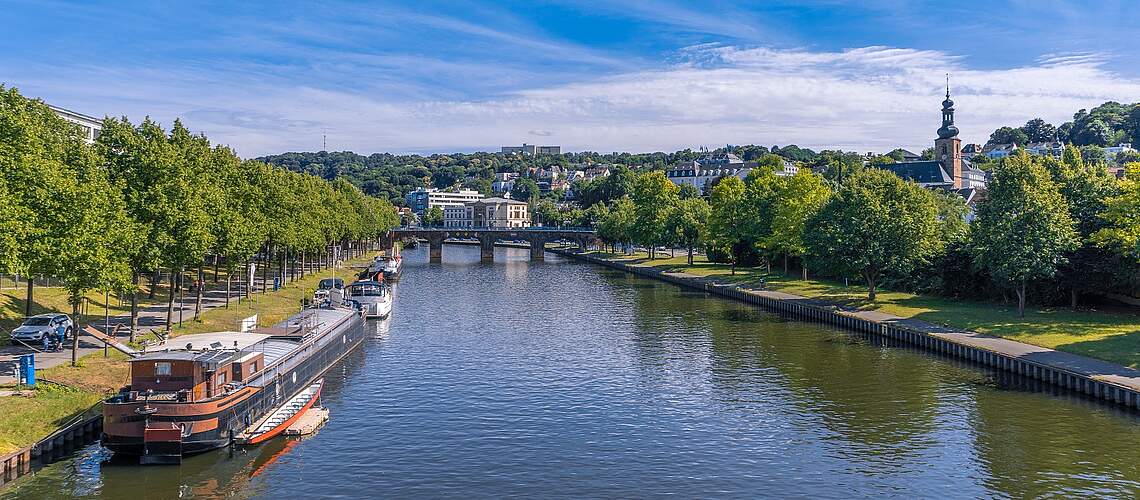
Regional Specialties in Germany – Part 2: Saarbrücken
Series: German Cuisine – Food at our locations
Saarland's regional cuisine is influenced by its proximity to the French border and its former affiliation with France. Side dishes such as sauerkraut and ingredients such as bacon and leeks come from neighboring Alsace-Lorraine. Coal mining also influenced the cuisine of this region. The physically demanding work resulted in hearty meals prepared from regional products. Even today, potato dishes are still common on regional menus.
Gefillde – not suitable as a snack
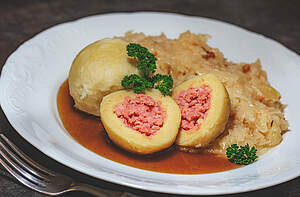
‘Gefillde’[1] are quite something. The dough, made from half raw and half cooked potatoes, is filled with a mixture of liverwurst (‘Leberwurst’[2]), minced pork, butter-roasted bread rolls and leeks. After cooking in a water bath, they are traditionally served with a bacon cream sauce and sauerkraut, both of which are ubiquitous in the Saarland. The cured meat and home-made liverwurst give the dish a hearty, savory taste. Wine sauerkraut is an equally intense side dish seasoned with juniper berries and bay leaves.
There are various alternative versions to the traditional recipe (stuffed cabbage rolls with meat and bacon), such as stuffed cabbage rolls with salmon filling and leek cream sauce. For vegetarians, there are delicious recipes with an eggplant filling.
[1] Dialect, in standard German: ‘Gefüllte’ (derived from the verb ‘füllen’ (to fill, to stuff)
[2] Home-made sausage made from pork
Geheirade – mix of boiled potatoes and flour dumplings
The inexpensive dish ‘Geheirade’[3] is a classic recipe from Grandma's kitchen. First, the potatoes are boiled in salted water. True Saarlanders add plenty of Maggi seasoning and broth. Meanwhile, mix flour, mineral water, eggs, and a dash of milk into a foamy dough. Use a spoon to form dumplings and add them to the broth. After 10 minutes of cooking, they will float to the surface. Top the finished dish with a bacon cream sauce! Alternatively, leave out the bacon and replace it with toasted bread rolls for a lighter version. The hearty version with bacon is traditionally served with endive salad. The ‘crouton version’ tastes great with preserved fruit, such as mirabelle plums or damsons.
[3] Dialect, in standard German ‚Verheiratete‘ (marriage couple)
Dibbelabbes – Saarland potato pancakes

Dibbelabbes[4] are popular at Christmas markets and fairs because they are easy to prepare. Saarland potato pancakes are different due to their shape, ingredients, and mixing time. First, grate the raw potatoes, then mix in the eggs, diced onions, parsley or leeks, and dried meat. The only seasonings used are salt, pepper, and nutmeg. The dough is fried in oil in a pan. Turn it over and over. You end up with a layered mix of roasted and mashed potatoes. Dibbelabbes are typically served with apple sauce. At home, people also like to eat green salad as a side dish.
[4] Dialect, in standard German ‚Topflappen‘ (pot holder)
Bibbelsches Bohnesupp – Making a strong broth with careful preparation
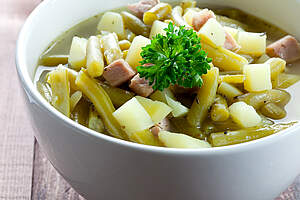
‘Bibbelsches’ or ‘Schnibbelsches Bohnesupp’[5] requires some preparation time since all the ingredients must be chopped into small pieces before adding them to the soup pot. In addition to green beans, the soup contains waxy potatoes, carrots, leeks, celery, an onion, savory, vegetable stock, and bacon. The soup is thickened with flour and deglazed with white balsamic vinegar. Salt, pepper, herbs, and nutmeg are added to taste. Mettwurst sausages[6] are often cooked with this hearty soup and then sliced and served on top.
This is traditionally served with ‘Kwetschekuche’[7]- but only afterwards, of course, since not everyone likes sweet things with savory soups.
[5] Dialect, in standard German ‚Geschnippelte Bohnensuppe‘ (chopped bean soup)
[6] Strongly flavored German sausage
[7] Dialect, in standard German ‚Zwetschgenkuchen‘ (plum cake)
Schwenker – Don’t call it barbecue!
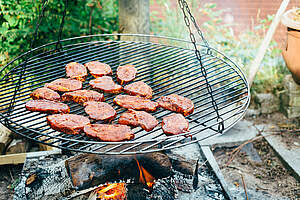
When the days get longer, the people of Saarland can hardly wait to start "schwenken". This special method means cooking marinated pork neck or shoulder over beech wood. Unlike conventional barbecuing, though, the typical ‘Schwenkmeister’ (barbecue chef) sets up a tripod. At the top of the tripod, you will find a roller with a chain threaded through it. This creates a trapeze in the middle to which a round grate is attached. The chain allows the food to be raised and lowered and enables the grill to be rotated or swung over the fire.
The term ‚Schwenker‘ not only refers to the grill itself, but also to the barbecue meat and the barbecue chef. It's admirable how seriously this hobby is pursued. ’Dei Vadder kann ned schwenke’[8] is an insult to someone from Saarland.
[8] Dialect, in standard German ‚Dein Vater kann den Schwenkgrill nicht bedienen.‘
(Your father can’t handle the sviwel grill‘).
The Saarland way of life is strongly influenced by French culinary culture. People enjoy spending long periods of time at the table, passing the time with a ‘Plausch’ (casual conversation). Our article on the Saarland dialect gives you an idea of what's being ‘geschwätzt’ (talked about) at the neighboring table.
